

An atmosphere of feeling of anticipation. I can see the frosty air emanating from my rivals as they execute the "about to run" wiggle on the starting line.
A rapid flick of the hips.
I'm lined up for my local 5km community parkrun and I mean business. The countdown begins...
Hold on. I need to sort my device. As does the runner alongside me.
The person in the line sighs. I'm not moving until… done! Connection established, I'm off.
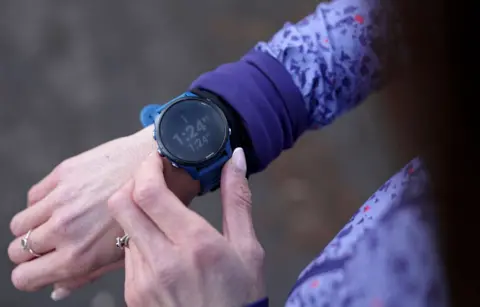
Amidst the crowd, it's difficult to find a arm without a wearable on it. And this extends beyond us runners who wear them.
It's a thriving, multi-billion dollar industry. Names like Samsung Galaxy lead the market, all offering an broad range of different models to cater to a range of budgets. Based on how high tech the watch you select, costs can start from a hundred pounds to thousands of pounds.
"It makes me crazy, I'm unable to switch off."
"It reassures me… It feels like a friend encouraging me."
"Stop telling me I've had a poor sleep."
A small sample of the reactions I've had from fellow device users when I question what they their opinion is on theirs.
A Sea of Statistics
My current opinion on my own device? Right now, irritating. It's indicating my speed is wrong, causing me to question whether the trees I'm running below are blocking my satellite signal.
Millions of us fasten these small gadgets onto our arms and use them 24/7, ostensibly comfortable with the fact they're perpetually monitoring us.
Gone are the days when we used them only to give us an rough count of our step count. Now, they can analyse our sleep patterns, stress levels, glucose levels, our VO2 max.
It's a challenge to find a health indicator they aren't designed to measure.
But can they do what they claim to do? And are the statistics we obsess over a faithful picture of the truth? Do they enhance our mental and physical wellbeing, or do the plethora of measurements and constant notifications just add to our everyday anxiety?

A Love-Hate Relationship
"I become a bit obsessed with mine," a wearer admits.
While she values how her device tracks her exercise, she finds some of its other features "excessive" at times - a feeling initially realised during a pregnancy.
Before she realised she could put it into a specific mode, her smartwatch constantly alerted her she was not being productive enough. Now, the watch frequently reports her she's had a bad night's sleep.
"I am caring for a six-month old, there's no point to be notified I'm tired," she says. "I know that all too clearly."
Couldn't she just stop wearing it?
"It's possible, I suppose, but I'm in this love-hate relationship with it," she continues. "I appreciate it for its fitness insights, I just wonder whether all the other things it can now do is maybe overkill for me."
How Do They Work?
Every device of smartwatch has its own unique way of measuring your health metrics and processing your data, but the vast bulk use sensors on the reverse of the watch.
They usually shine small, green LED lights onto your skin which can observe pulsation, identifying your heartbeat. More advanced devices measure changes in the bioimpedance that runs through the skin to get an idea of your stress levels.
Expert Perspectives
A data scientist says that overall for smartwatches, it's a "delicate equilibrium" - while the ever-evolving tech could realistically aid early diagnosis, "detecting disease before we show symptoms", it could also turn us watch wearers into the "worried well".
He points out that some of the latest wearables can perform tests like medical-grade monitoring, which constantly monitor how healthy the heart is. They can notify if someone is experiencing a heart arrhythmia, where there is erratic electrical activity in the heart causing an arrhythmia.
This does not automatically signal someone is imminently going to suffer a cardiac event, but it can give an preliminary indication they might be more vulnerable of a blood clot in the long term.
But how to understand these numbers is complex. The expert worries that as more functions are introduced, people may find it hard to fully comprehend their data.
"I remain sceptical that having the capacity to monitor so many metrics is such a positive development," he says.
A health researcher specialising in patient behaviour concurs. Research into the impact of wearable tech on a cohort of heart condition patients suggested a noticeable percentage of those who were given devices to monitor their condition experienced heightened worry and were "far more likely to use doctor's time".
She identified a pattern with her patients - they spotted a alarming metric on their watch. They felt anxious. Their BPM went up. They got more worried. They looked a second time, and their reading increased again.
"Upon viewing data about ourselves that we don't really understand then, understandably, we are going to want to know more," the psychologist says. "We check, we obsess - it becomes a self-fulfilling prophecy."


